
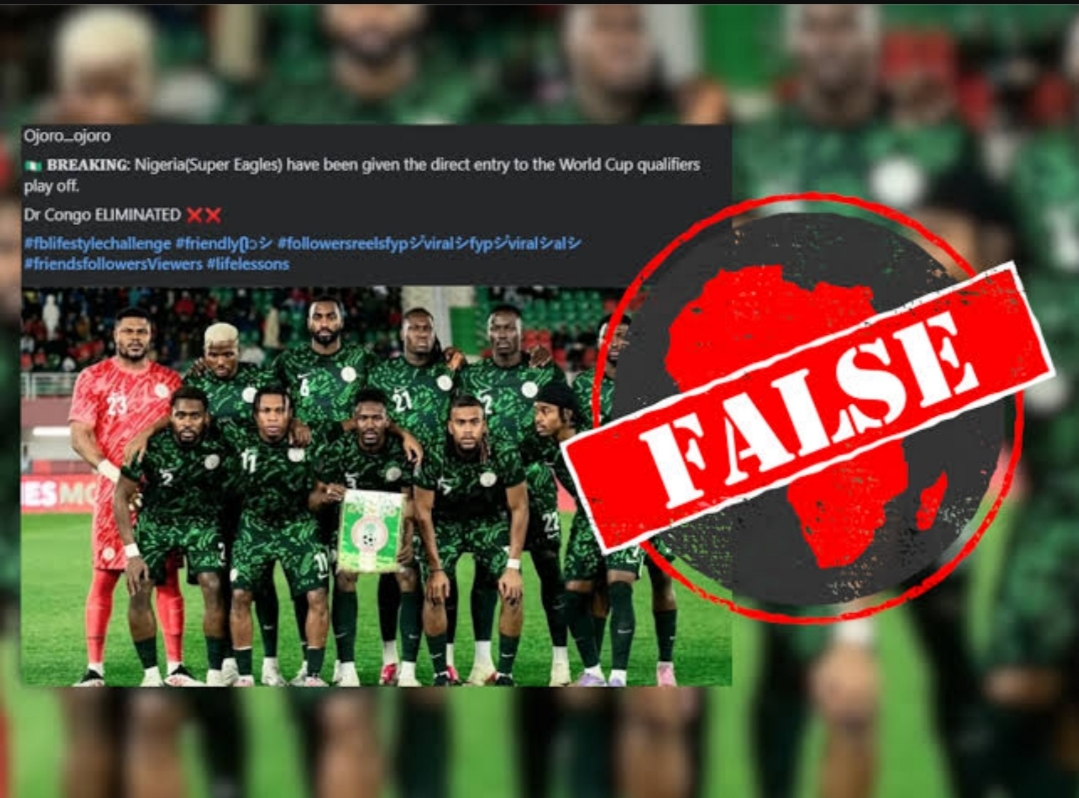


Nigeria Super Eagles’ 2026 World Cup heartbreak has been reopened by a remarkable eligibility case involving DR Congo goalkeeper Lionel Mpasi, Footynaija reports.
Documents recently reviewed by The New York Times raised questions about what FIFA knew, when it knew it and why no sporting sanction followed.
The central issue is straightforward. Mpasi was born in France and represented the country at youth level, including at the 2011 FIFA U-17 World Cup. DR Congo began the process of changing his international allegiance in 2021, but documents cited in the investigation indicate that the process was never properly completed.
Related Post


Yet Mpasi played against Nigeria in the decisive African play-off final on 16 November 2025, then continued with DR Congo as the Leopards secured their place at the World Cup.
The controversy is now about what FIFA did after the complaint reached its disciplinary machinery.
November 16, 2025: Mpasi stands between Nigeria and the World Cup
Nigeria entered the African play-off final in Rabat knowing victory over DR Congo would send the Super Eagles into the intercontinental play-off.
Frank Onyeka put Nigeria ahead after only three minutes at the Prince Moulay El Hassan Stadium. Meschak Elia equalised in the 32nd minute. Neither side found a winner during the remaining 90 minutes or extra time.
Mpasi was in goal for the full 120 minutes. He then helped DR Congo win 4-3 on penalties after Nigeria missed through Calvin Bassey and Moses Simon.
Chancel Mbemba converted the decisive kick, ending Nigeria’s route to the World Cup and sending DR Congo into the intercontinental play-off.
That result initially appeared final until it was not.
December 2025: Nigeria challenge DR Congo’s eligibility
The NFF subsequently submitted a complaint to FIFA questioning the eligibility of several DR Congo players.
The case went beyond Mpasi. Nigeria also questioned the status of foreign-born players, including Aaron Wan-Bissaka and Axel Tuanzebe, and argued that some players held European passports despite DR Congo’s restrictions on dual nationality.
The NFF maintained that FIFA had been misled when the players were cleared.
The complaint eventually became a much more consequential case than the penalty shootout itself because FIFA’s subsequent investigation reportedly uncovered a problem with Mpasi’s international switch.
March 2026: FIFA lawyers reportedly discover the Mpasi problem
This is the most important development in the entire affair. According to documents reviewed by The New York Times and separately reported by Le Monde, FIFA’s legal officials discovered in March 2026 that Mpasi’s change of international association from France to DR Congo had not been completed.
The timing mattered enormously. DR Congo had already eliminated Nigeria. The Leopards were preparing for the intercontinental play-off against Jamaica, where victory would take them to the World Cup.
FIFA officials reportedly considered several possible responses. One option was to award Nigeria the match. Another was to replace DR Congo with Nigeria in the play-off against Jamaica. FIFA also considered imposing a financial sanction.
The fourth option was to reject Nigeria’s case on procedural grounds. Unfortunately, that was the route ultimately taken.
The technicality that changed Nigeria’s fate
FIFA’s position was that Nigeria’s complaint did not satisfy the required procedures.
Reports have identified the timing of the protest as one of the central grounds for dismissal. Other reporting has also cited issues surrounding the filing process and the required CHF1,000 fee.
Still, the case was dismissed without a sporting punishment that altered the qualifying pathway.
FIFA has defended the decision, telling The New York Times that its committees are autonomous and make decisions according to the applicable regulations and the facts before them. FIFA also said Gianni Infantino had no influence over the decision.
March 2026: DR Congo beats Jamaica and reaches the World Cup
With no sporting sanction imposed, DR Congo faced Jamaica in the FIFA Play-Off Tournament. The Leopards won and secured their first World Cup appearance in 52 years.
That left Nigeria without a World Cup appearance since 2018.
Had FIFA replaced DR Congo with Nigeria, as one of the options reportedly considered, the Super Eagles could have taken the Leopards’ place in the intercontinental play-off.
The precedent question: Greece and Bolivia
One of the sharpest questions facing FIFA is consistency.
In 2016, Greece were punished with a 3-0 defeat after fielding an ineligible player who had previously represented Australia at youth level.
In 2018 World Cup qualifying, Bolivia also suffered sporting consequences after an ineligible player who had represented Paraguay was used.
Those cases have become central to the current debate because the reported Mpasi finding also concerned an incomplete international switch.
With Mpasi’s paperwork confirmed to be incomplete, the issue now is whether FIFA’s response to that breach was consistent with its treatment of comparable cases.
Where Véron Mosengo-Omba enters the story
The political dimension of the entire controversy centres on Véron Mosengo-Omba.
The Swiss-Congolese administrator was CAF secretary-general when the controversy unfolded and has long been associated with FIFA president Gianni Infantino. He had also been preparing his bid to lead DR Congo’s football federation.
Two months after DR Congo secured its World Cup place, Mosengo-Omba was elected president of FECOFA. He won 60 votes at the May 20 election and became the sole candidate in the process.
That sequence has fuelled allegations of a possible conflict of interest.
It does not, by itself, prove that Mosengo-Omba influenced FIFA’s eligibility decision or that Infantino intervened.
Mosengo-Omba has said he was unaware of FIFA’s findings concerning Mpasi, while FIFA has explicitly denied that Infantino influenced the decision.
What FIFA says and what the evidence shows
Three facts now sit at the heart of the dispute. First, Nigeria lost the November 2025 play-off final to DR Congo on penalties after a 1-1 draw.
Second, FIFA’s internal legal review reportedly found that Mpasi had not completed the necessary process to switch his international allegiance from France.
Third, FIFA did not impose a sporting sanction that removed DR Congo from the route to the World Cup, instead dismissing Nigeria’s complaint on procedural grounds.
The fourth issue is an allegation, not an established fact: that FIFA’s decision was influenced by political relationships involving Infantino and Mosengo-Omba. FIFA rejects that suggestion.
What happens next?
The controversy has now moved beyond Nigerian anger over a penalty shootout.
Former NFF president Ibrahim Gusau has called for an investigation, saying Nigerian officials were told their complaint had been rejected for technical reasons but were not informed of the reported FIFA finding concerning Mpasi.
The NFF and Nigerian authorities must now decide whether there is a legal route to challenge FIFA’s handling of the case or seek compensation.
Nothing in the latest revelations automatically gives Nigeria the World Cup place it lost in Rabat. The tournament has already been played and DR Congo competed in it.
What the revelations do is reopen the chain of decisions that led from Mpasi’s appearance against Nigeria to DR Congo’s qualification.
The Super Eagles lost the shootout. But the new controversy asks whether that should have been the final word.