



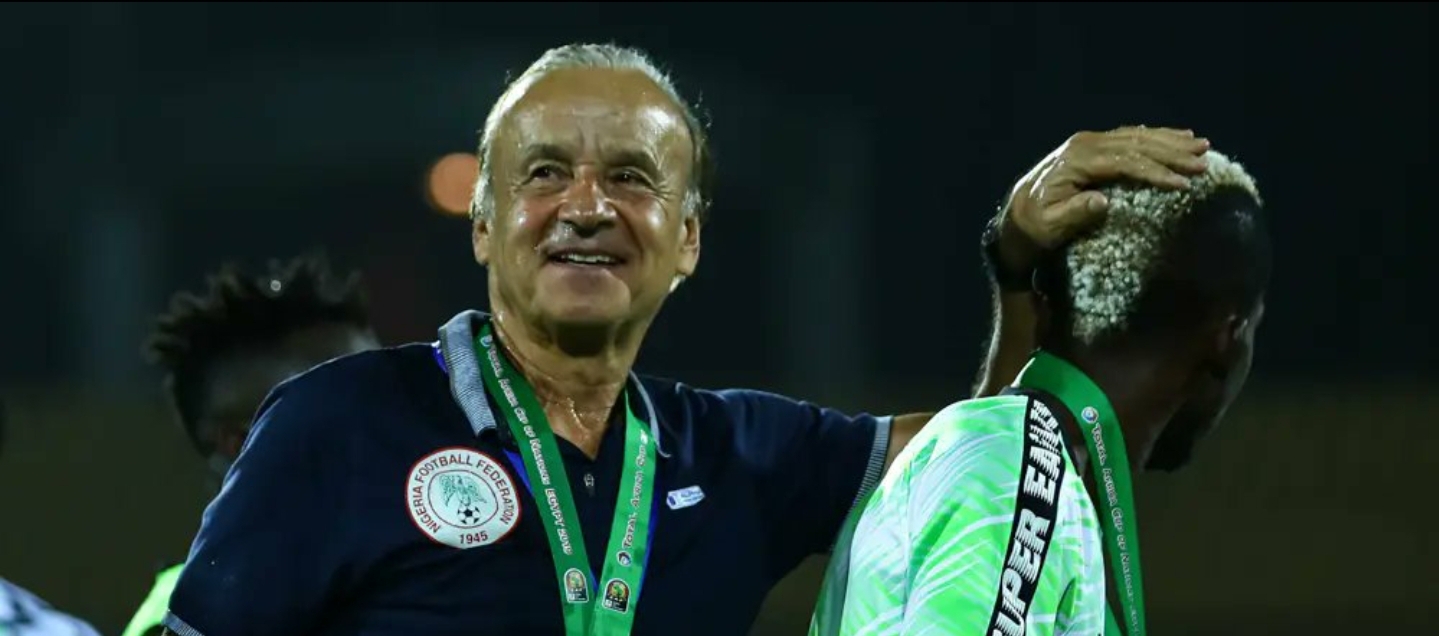


Gernot Rohr has lifted the lid on a failed attempt to convince Michael Olise to represent Nigeria, revealing that the Bayern Munich winger rejected an approach from the Super Eagles in 2019 because he had already set his sights on a future in European club football, Footynaija.com reports.
Olise, 24, was born in Hammersmith, London, to a British-Nigerian father of Urhobo heritage and a Franco-Algerian mother, making him eligible for four nations: Nigeria, France, England and Algeria.
He was placed on Nigeria’s standby list for AFCON qualifiers in March 2021 but was never capped, and has since committed to France, making his senior debut against Italy in September 2024. He is now cap-tied to Les Bleus.
Related Post





Rohr, who managed the Super Eagles between 2016 and 2021, personally travelled to watch Olise play for Fortuna Düsseldorf’s youth setup during the 2018-19 season, accompanied by his assistant Tunde. The scout report was glowing, the approach that followed, however, was not.
‘He already knew he had a big future in Europe’
Speaking to Brila, Rohr recalled exactly how the conversation went.
“In 2019, I saw this player and I had a look on him with my assistant, Tunde. We went to watch a match and we tried to invite him but he did not want to join us at the time,” he said.

Rohr did not blame the player for the decision, pointing instead to the ambition that was already evident in a teenager who would go on to become one of the best wingers in the world.
“I think he already knew he can have a big future in a European team and can play for several countries, of course,” the former Nigeria coach added.
“This player, six or seven years ago when we saw him, was so strong. Unfortunately, he refused to play for Nigeria.”
Olise has since justified every bit of that self-belief. He moved from Reading to Crystal Palace, then to Bayern Munich in July 2024 for €60 million.
This season he has contributed 13 goals and 20 assists in 30 Bundesliga appearances, and Bayern face PSG in the Champions League final stage on May 6 where he will be one of their most dangerous attacking threats.
For Nigeria, the what-if remains a painful one.